
The Mirrored Spiral is a model for examining personal development through the relationship between our internal and external worlds. It builds upon the process of self-creation by expanding the individual’s attention outward—from the parts of life most directly under personal control toward increasingly larger systems that affect us and that we, in turn, may learn to influence.
The eight areas, in sequence, are:
- Mental 5. Financial
- Physical 6. Career
- Emotional 7. Family
- Spiritual 8. Social
The first four form the Inner Mirror, while the second four form the Outer Mirror.
The distinction between the two mirrors is important. Your ability to influence what exists outside of you is closely related to the development and control you establish within yourself.
The Inner Mirror represents those aspects of yourself over which you possess the greatest direct control, although other people and outside circumstances can influence them. The Inner Mirror you control, though others may influence it.
The Outer Mirror represents areas containing structures, circumstances and other people that you do not control. Those systems exercise varying degrees of control over your life, but through the development of yourself and the choices you make, you can learn to influence your relationship with them. The Outer Mirror others control, though you may influence it.
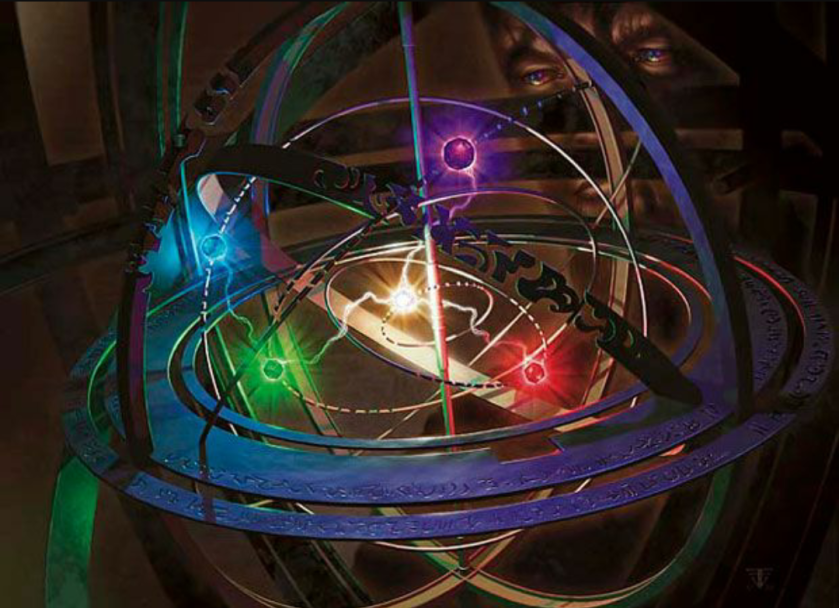
Using the Mirrored Spiral
At its simplest, the model can be drawn as two concentric circles containing eight positions. Begin by drawing a large circle and then a smaller circle within it. Then label each of the positions in the following sequence:
Inner Circle: Right (1. Mental), Bottom (2. Physical), Left (3. Emotional), Top (4. Spiritual)
Outer Circle: Bottom (5. Financial), Left (6. Career), Top (7. Family), Right (8. Social)
Then begin asking questions.
Where am I now? What have I already developed? Where am I weak? Where am I strong? Which areas of my external life are being affected by conditions within me? Which external circumstances are influencing my internal development? What can I actually control? What can I only influence? And what would have to develop within me before I could exert greater influence upon what currently lies beyond my control?
From those questions, choose goals.
The goals themselves belong to you. They should reflect your circumstances, values, abilities and direction rather than someone else’s definition of what your life should become. And the goals you choose should challenge you. Because the achievement of a goal is only part of its purpose. The true value of a goal lies not simply in reaching it, but in the person you become on the way to achieving it. Every completed turn gives you somewhere new from which to look. And from that new position, the mirrors change again.
The Inner Mirror
The first four positions begin with the individual.
Mental asks you to examine your thoughts, beliefs, perceptions, assumptions and patterns of attention.
Physical turns toward the body, behavior, habits, health, discipline and your interaction with the material environment.
Emotional concerns your relationship with feeling: how emotions arise, how they influence perception and behavior, and how effectively you can understand, express and regulate them.
Spiritual asks larger questions of meaning, values, purpose, connection and the principles according to which you choose to live.
These four areas constitute the Inner Mirror because development begins with the person looking into it. Other people can affect what you think. Circumstances can affect your body. Relationships can affect your emotions. Cultures and traditions can influence your spirituality. But ultimately, the work performed within these areas belongs to you.
The Outer Mirror
From the fifth position onward, the scale expands more visibly beyond the individual.
Financial concerns your relationship with money, resources, needs, wants, security and the consequences created by how resources are obtained, managed and used.
Career places the individual within larger, long-term organized structures. Here personal ability encounters responsibility, hierarchy, cooperation, competition, leadership and systems containing goals beyond those of any single participant.
Family expands the field further into an interconnected human system involving history, relationships, obligations, roles, boundaries and generations.
Social moves into the still larger environment of communities, institutions, cultures and societies within which both individuals and smaller groups exist.
These are called the Outer Mirror because none belongs entirely to you. You cannot personally control an economy, an organization, another family member, or an entire society. They possess structures and forces of their own, and those forces can exert considerable control over the circumstances of an individual’s life. What you can develop is your ability to interact with them intelligently and influence what is within your reach. And that returns us to the Inner Mirror.
Although the Mirrored Spiral is represented on paper as two circles, the circles are only a two-dimensional representation. Imagine also that each position rises slightly higher from the one before it. Mental leads upward toward Physical. Physical leads toward Emotional. Emotional toward Spiritual. The movement then continues outward into Financial, Career, Family and Social. Viewed three-dimensionally, the apparently flat circles begin to form an expanding spiral.
This is why the sequence matters.
Each position provides experiences, abilities, and perspectives that affect the positions that follow it. Development accumulates. What you learn about your thoughts affects how you relate to your body. Your relationship with your physical existence affects your emotional experience. Mental, physical and emotional development affect the way you understand meaning, purpose and spirituality.
And what develops internally eventually meets the external world.
Your internal condition influences how you manage resources. Resources affect the possibilities available within a career. Career and financial circumstances interact with family life. All of these contribute to the way you participate in the larger social environment. None exists completely by itself. Each becomes another turn of the spiral.
The Mirrored Spiral is therefore not simply about setting eight different kinds of goals. It is about learning the difference between control and influence. Development begins closest to the point at which your control is greatest: yourself. As the spiral expands, direct control decreases while the number of relationships, variables and perspectives increases.
That change in scale also changes what you can see.
Standing immediately beside a tree allows you to examine its bark but makes it difficult to see the forest. From above the forest, relationships between thousands of trees become visible, while the details of any individual tree become harder to perceive.
Neither perspective is inherently superior. They answer different questions. Personal development gradually gives you more positions from which to look. You learn to examine something closely enough to understand its details and to move far enough away to recognize the larger pattern in which those details exist. The purpose is not simply to climb higher and remain there. It is to develop the ability to move between perspectives and bring what you learn from one level into another.
The spiral also moves in more than one direction. Sometimes development requires expansion upward and outward so that a larger perspective can be gained. At other times, it requires movement downward and inward. There are parts of ourselves that cannot be understood merely by trying to rise above them. Memories, fears, emotional patterns, contradictions and unresolved experiences may require us to descend into ourselves and examine what exists beneath the surface. Decent provides understanding. Ascent provides perspective. But neither is complete without a return to the present. Whatever is discovered below must eventually be brought back into present life. Whatever perspective is gained above must likewise return to the level at which choices are actually made. Otherwise insight remains only insight. The value of development lies in what can be integrated and lived.
 Mindspring Connections