Finding Meaning And Learning To Live It
Spirituality is difficult to discuss without eventually encountering belief. What do we believe exists? What do we believe we are? Why are we here? Is there something larger than ourselves? What happens when we die? What gives life meaning? Different religions, philosophies, esoteric traditions and spiritual practices have spent thousands of years developing answers to questions like these. I have my own answers. Other people have theirs.
But for personal development, I think there’s another question worth asking before trying to settle all of them: What does our spirituality actually do within the life we’re living?
Because spirituality can provide extraordinary experiences, symbols, philosophies and perspectives. But eventually we have to come back from all of them. Eventually we return to the person standing here. And then we have to live.
Spirituality And Religion Aren’t Necessarily The Same Thing
For many people, spirituality and religion are inseparable. A religious tradition can provide a complete spiritual framework: practices, community, ethics, cosmology, symbolism, ritual and answers to questions concerning meaning and existence. For others, spirituality develops differently. It may involve contemplative practice. Nature. Philosophy. Meditation. Mysticism. Esoteric traditions. Ritual. Personal experiences. Or some combination accumulated across a lifetime.
I don’t think we need to force all of these into the same category beyond recognizing that human beings repeatedly search for ways to understand their relationship to something larger than their immediate individual existence. That larger context might be understood very differently from one person to another. The important developmental question isn’t whether everyone reaches the same answer. It’s whether we’ve actually examined our own.
What Do We Believe?
Many of our earliest spiritual ideas aren’t conclusions we independently reached. We inherit them. From family. Culture. Religion. Community. History. Sometimes those beliefs remain with us throughout life. Sometimes we reject them. Sometimes we leave them and eventually return with a different understanding. Sometimes we encounter other traditions and discover ideas that reshape everything we previously believed. There is nothing inherently wrong with inherited belief. Almost everything we learn begins somewhere outside ourselves.
But eventually development may ask us to examine it. What do I actually believe? Why? Which parts come from experience? Which come from tradition? Which have I investigated? Which have I accepted because people I trusted taught them to me? Which have I rejected primarily because people I distrusted believed them? What happens when two traditions describe similar experiences differently? What happens when they contradict each other? Spiritual development can involve becoming increasingly conscious of the framework through which we’re interpreting these questions.
Practice And Belief Are Different Things
One of the reasons esoteric and contemplative practices have been important in my own development is that they aren’t merely collections of propositions about reality. They’re things we do. Meditation is something we practice. Ritual is something we perform. Breathing practices involve the body. Contemplation directs attention. Symbolic work gives us ways of organizing and interacting with ideas.
Different practices can develop concentration, patience, imagination, self-observation, emotional awareness, bodily awareness, and discipline regardless of how someone ultimately interprets the metaphysics surrounding them. That distinction interests me.
We can ask two different questions: What does this tradition say is happening? And What capacities am I actually developing by doing the practice?
Those questions don’t have to produce identical answers. Psychology can sometimes provide one language for understanding a practice. A spiritual tradition may provide another. An esoteric system may provide another still. We don’t necessarily have to collapse one into another before we’re allowed to learn something from the comparison. Sometimes examining the same experience through several frameworks gives us a broader view of what the practice is doing.
Symbolism Gives Us Another Language
Spiritual and esoteric traditions frequently communicate through symbols: animals, elements, colors, directions, numbers, stories, deities, archetypal figures, cycles, death and rebirth, descent and ascent, light and darkness. Symbols can contain relationships that become difficult to communicate through literal language alone.
That’s one reason symbolism has played such a significant role in my own work. But a symbol shouldn’t necessarily end inquiry. It can begin it. What does this represent? Why does it resonate? What qualities have we associated with it? Where did those associations come from? How does the symbol change when viewed through another tradition? What psychological function might correspond with it? What does interacting with that symbol reveal about us?
A symbol can become another mirror. We look into it. What we see can tell us something about the symbol. It can also tell us something about the person doing the looking.
Spirituality Can Take Us Into Depth
Spirituality isn’t always about moving upward. Some of the most important spiritual material is found below the surface. Traditions throughout history have used images of caves, wilderness, underworlds, darkness, death, trials and descent. Psychological language may describe some related processes differently, but the developmental principle is recognizable. Sometimes we have to enter places within ourselves that we’d rather avoid. Fear. Grief. Shame. Loss. Mortality. Uncertainty. The unknown. Parts of ourselves that don’t fit comfortably within the person we prefer to believe we are.
I don’t see darkness as something that simply needs to be defeated by accumulating more light. Sometimes darkness contains information that isn’t visible anywhere else. We descend because something is there. But descent isn’t the destination. Eventually we return.
Spirituality Can Also Give Us Perspective
The opposite movement matters too. Sometimes we need to rise above our immediate circumstances. A problem that fills our entire field of vision from one position may look very different when placed within the context of a year. A lifetime. A generation. Human history. Life itself. Spirituality can provide perspectives large enough to fundamentally change how we understand our immediate experience. That can be enormously valuable.
But there is a danger here as well. Perspective can become escape. We can become so interested in transcendence that ordinary existence begins to seem beneath us. The body becomes something to escape. Emotion becomes something to rise above. Material responsibilities become distractions. Other people’s ordinary concerns become evidence that they simply aren’t sufficiently enlightened. At that point, spirituality can become another way of avoiding the very life it was supposed to help us understand.
Where We Are Now
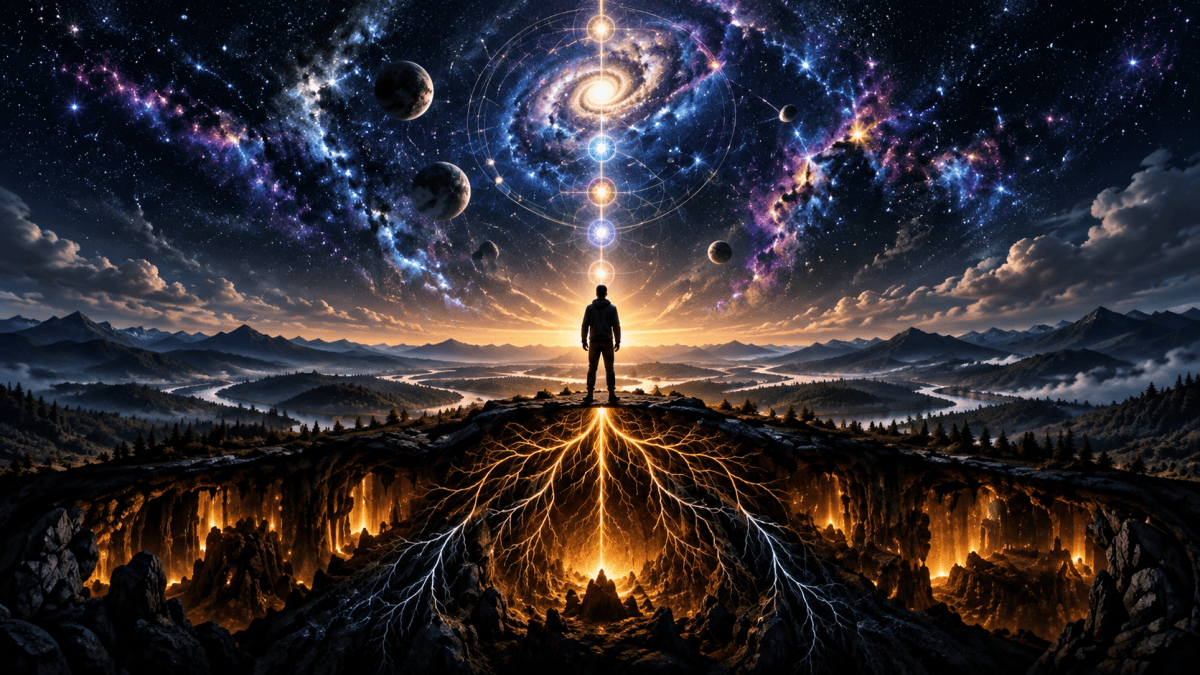
This is where my own position becomes fairly simple. Go down when depth is required. Come back. Go up when perspective is required. Come back. The present is the integration point.
Whatever we discover through spiritual practice eventually has to encounter ordinary life. If meditation teaches us compassion, what happens when somebody irritates us? If we believe everything is connected, how does that affect how we participate in those connections? If ritual gives us clarity, what do we do with the clarity afterward? If a spiritual experience changes our understanding of ourselves, where does that change become visible? If we claim to value peace, truth, discipline, love, courage or compassion, can those values survive contact with difficult circumstances?
A spiritual insight that never changes anything about the way we participate in life may still have been meaningful. But from a developmental standpoint, integration remains unfinished.
Spirituality Doesn’t Eliminate The Other Parts Of Us
Spirituality is one part of a larger person. We still have minds. Bodies. Emotions. Relationships. Responsibilities. Limitations. Desires. History. We don’t become less embodied because our spiritual understanding becomes more sophisticated. If anything, greater perspective should give us more opportunities to consciously integrate these parts.
The mind helps us examine spiritual ideas. Emotion tells us how experiences affect us. The body gives practice a physical location. Spirituality can give all of them a larger context of meaning. Then each influences the others. This is why I don’t find strict separation particularly useful. Development happens through the whole system.
We Don’t Need The Same Answers To Ask The Same Questions
I don’t expect everyone to reach my spiritual conclusions. That isn’t necessary for the questions to have value. What gives your life meaning? What do you believe you are part of? What responsibilities follow from that belief? What practices help you experience that relationship rather than merely think about it? Which beliefs have you inherited? Which have you examined? What experiences have changed them? How do you respond when experience contradicts belief? What symbols organize your understanding? Where does your spirituality challenge you? Where does it comfort you? Where might you be using it to avoid something? And perhaps most importantly: Where does what you believe become visible in how you live?
Spirituality can take us extraordinary places. Into ancient traditions. Into ourselves. Into symbolism. Into contemplation. Into questions for which humanity may never produce universally accepted answers. I don’t think we need to eliminate that mystery. Mystery itself can be part of the experience.
But however far we travel in search of meaning, eventually we find ourselves back in the present. In a body. With thoughts. With emotions. Surrounded by other people. Facing another choice. And perhaps that’s one of the most useful measures of spiritual development. Not merely how high we can climb or how deeply we can descend, but what we are capable of bringing back with us. Because spirituality can change the way we understand life. Integration is where that understanding begins changing the way we live it.

